Contents
The gap between knowing the rules and knowing the culture
Japanese gyms are, on the surface, similar to gyms anywhere. You come in, you exercise, you leave. The equipment works the same way. The results are the same.
But there's a layer of unwritten social norms that governs behavior in a Japanese gym — rules that aren't posted anywhere, aren't explained at sign-up, and aren't enforced by staff in any obvious way. Breaking these norms won't get you kicked out, but it will make other members uncomfortable and staff awkward. More practically, it will mark you as someone who doesn't understand the environment you're in.
These aren't exotic rules. Most of them come from Japan's broader social values: consideration for others (迷惑をかけない, meiwaku wo kakenai — don't cause inconvenience to others), cleanliness, and a general preference for low-key, non-disruptive behavior in shared spaces.
Here's what you need to know.
1. Wipe the equipment. Every single time.
This is rule one and the most universally enforced social norm in any Japanese gym. After you use a machine, bench, or mat, wipe it down with the provided spray and cloth before walking away. This isn't optional.
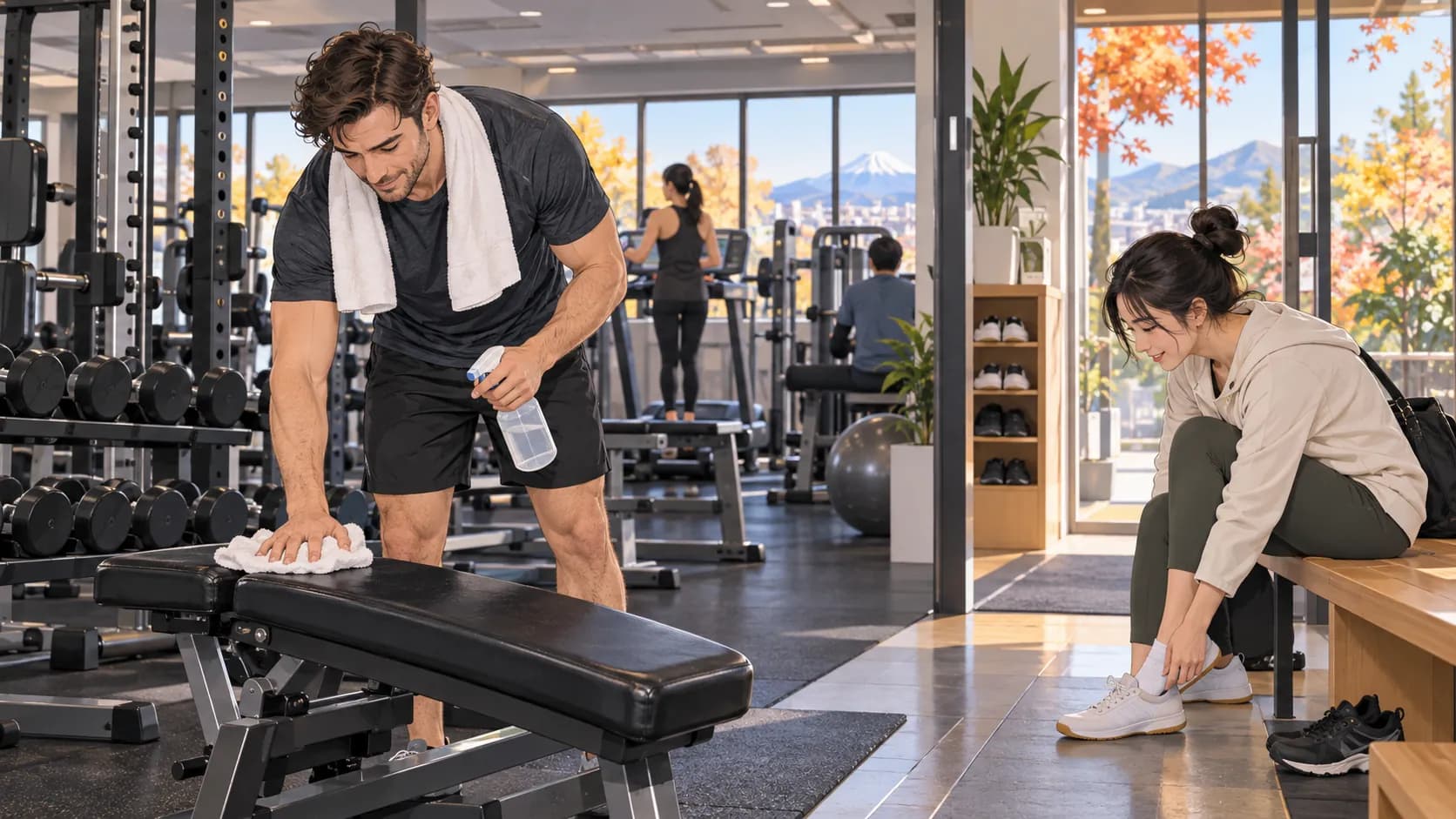
The wipe stations (spray bottle and towel or paper towel roll) are placed throughout the gym floor specifically for this purpose. Use them between every exercise, not just at the end of your workout.
In many Japanese gyms, other members will notice if you skip this. It's one of the few things that can earn you a disapproving look — or, more likely, a silent, deeply uncomfortable energy from the person who uses the machine after you.
2. The locker room and changing area are phone-free zones
This is critically important and not always obvious to foreigners from countries where people casually scroll through phones in changing areas.
No phones in locker rooms. This is about privacy protection — cameras in smartphones could be used to photograph other members changing. Most gyms have explicit signs saying so. Even if you're only checking a message, taking a phone into a changing room is a serious violation of social trust in Japan.
Keep your phone in your bag, in your locker, or in your pocket while in the locker room. Access it on the gym floor or outside.
3. No grunting, or at least keep it minimal
Japanese gym culture is quiet. Weight rooms in Japan have a noticeably different sound level than equivalent gyms in the US, Australia, or Europe. Members here lift seriously and push themselves hard, but the sound output is minimal.
Loud grunting, yelling, or barbell drops are rare and will draw attention. If you're used to vocalizing during heavy lifts, be aware that it will stand out here. It won't get you thrown out, but it will make the room tense.
Related: dropping weights. Most Japanese gyms have rubber flooring and allow some level of controlled weight lowering, but dropping barbells or dumbbells with a crash is not the norm. Lower the weights with control.
4. Don't give unsolicited advice to other members
This one goes both ways but is worth mentioning. Even in countries where "bro culture" gym coaching is common (strangers offering unsolicited form tips), Japanese gyms are more reserved. Members keep to themselves.
If you see someone using a machine incorrectly or with what looks like dangerous form, it's genuinely not your place to intervene unless they're about to injure themselves in a serious way. Even then, approach carefully.
Similarly, don't expect random helpful corrections from Japanese members. They'll notice things, but they won't say anything. If you want feedback on your technique, ask a staff member or hire a trainer.
5. Manage your towel situation
Many Japanese gyms require you to bring or rent a towel — not as an afterthought, but as a core part of gym etiquette. The expectation is that you carry a small towel with you during your workout to wipe sweat off yourself and to place on benches before you use them.
Sitting directly on a bench without a towel between you and the leather is considered unhygienic in Japanese gym culture. Not everyone follows this perfectly, but it's the norm and staff at some facilities will remind you.
Bring a hand towel for use on the floor. Bring a larger towel for the shower if you plan to use one.
6. Reserve machines by leaving a towel — but don't abuse it
Leaving your towel or water bottle on a machine while you rest between sets is the standard way to signal that you're using it. This is widely understood and accepted.
However: the expectation is that you are actively using the machine in a normal set/rest cycle. Long rest periods (more than 3–5 minutes), extended phone scrolling between sets while a towel "saves" a machine, or reserving two pieces of equipment simultaneously during busy hours will cause friction. During peak hours (weekday evenings, weekend mornings), be mindful of how long you're occupying shared equipment.
7. Speaking volume on the gym floor
The gym floor isn't silent, but conversations are kept at a moderate volume. If you're training with a friend and want to chat between sets, keep it to a normal conversational volume. Loud, expansive conversations — especially in a language other than Japanese, which can stand out aurally — will draw attention.
This isn't about discrimination or language preference; it's about the general audio environment of a Japanese shared space. The same norm applies to Japanese members speaking Japanese loudly.
8. Re-rack weights to the correct position
After using dumbbells, plates, or any free weights, return them to exactly the rack position they came from. In Japan, this is taken seriously. Dumbbells go back in weight order. Plates go back on the correct pegs.
A subtle but important corollary: if you used weight clips (collars) on a barbell, replace them. If you moved anything to create space for your workout, return it when you're done.
9. Showers and sauna etiquette
This is one area where Japanese gym culture differs significantly from many other countries.
Sit on a stool, not standing: In gyms with traditional shower rooms (particularly at full-service clubs like Konami Sports or Central Sports), the shower area has individual small stools and showerheads at seated height. The expectation is that you sit to shower, washing thoroughly before entering the communal bathing area if there is one.
No swimwear in the sauna or bath: Japanese communal bathing is done without clothing. If the gym has a communal bath or sauna, you enter without a swimsuit (you may wrap a small towel around yourself, but wearing swimwear is inappropriate).
Rinse before using communal facilities: If there's a hot tub or communal bath, rinse thoroughly in the shower area first. This is non-negotiable in Japanese bathing culture.
24-hour gym chains like Anytime Fitness and Joyfit24 typically have individual shower stalls rather than communal bathing — this etiquette is more relevant at traditional full-service clubs.
10. Don't use your phone on the gym floor for calls
Taking a phone call on the gym floor is unusual in Japan. If your phone rings and you need to answer, step outside or into a hallway. The same applies to video calls.
Using your phone to check your training app, log sets, or scroll between exercises is entirely normal — it's specifically the audio component (conversation, video with sound) that's disruptive by local norms.
11. Understand queue culture for busy equipment
At peak hours, popular equipment (cable machines, specific benches, squat racks) can have informal queues. The Japanese queue culture extends into gyms: people wait patiently without overtly cutting, and the sequence is generally respected.
If you want to use a piece of equipment that someone else is using, the correct approach is to ask quietly "次、使ってもいいですか?" (tsugi, tsukatte mo ii desu ka? — "May I use this next?"), or simply wait nearby until they're done. Don't ask during their active set — wait until they're in a rest period.
12. Changing area behavior at gender-specific sections
In Japanese gyms, the separation between men's and women's areas is strict and carefully observed. Stay in your designated area. Even momentarily entering the wrong changing area by mistake will cause significant discomfort.
If you're unsure about a facility's layout (some gyms have changing rooms that aren't immediately obvious in their signage), ask staff before going through any door marked with Japanese characters you're not certain about.
13. Perfume and cologne — less is more
This is increasingly common in Japanese gym rules explicitly, but even where it isn't posted: strong scents (perfume, cologne, heavily scented lotions) are considered a form of inconvenience to others (meiwaku) in enclosed shared spaces. Many Japanese people are sensitive to fragrance, and enclosed gym environments intensify smells.
Keep any scent products minimal before going to the gym.
A note on how these norms are enforced
Almost none of these rules are explicitly enforced by Japanese gym staff in a confrontational way. Staff will not usually walk up and tell you that you forgot to wipe the machine or that you were too loud. What they will do is give polite reminders through general announcements, or a staff member might quietly demonstrate the behavior (wiping the machine themselves nearby) in a way that signals the expectation without confronting you directly.
This indirect communication style (遠回し, tōmawashi) means you may not realize you're doing something wrong until you pick up on subtle cues. The best approach is to observe what other members do in the first few visits and mirror the behavior — you'll pick up the norms quickly.
The positive flip side
Japanese gym culture has real advantages for many people. The quiet environment means you can focus without background noise. Nobody will approach you for unsolicited conversation. The machines are clean. Equipment is almost always returned to its proper place. And the general atmosphere of mutual consideration makes it a more comfortable space for people who don't want to perform their workout for an audience.
Once you understand the norms, a Japanese gym is one of the better places in the world to train consistently without social friction. The rules exist not to exclude or judge, but to maintain a shared space that works well for everyone who uses it.
Find gyms across Japan on fitnessgym.jp → Search gyms